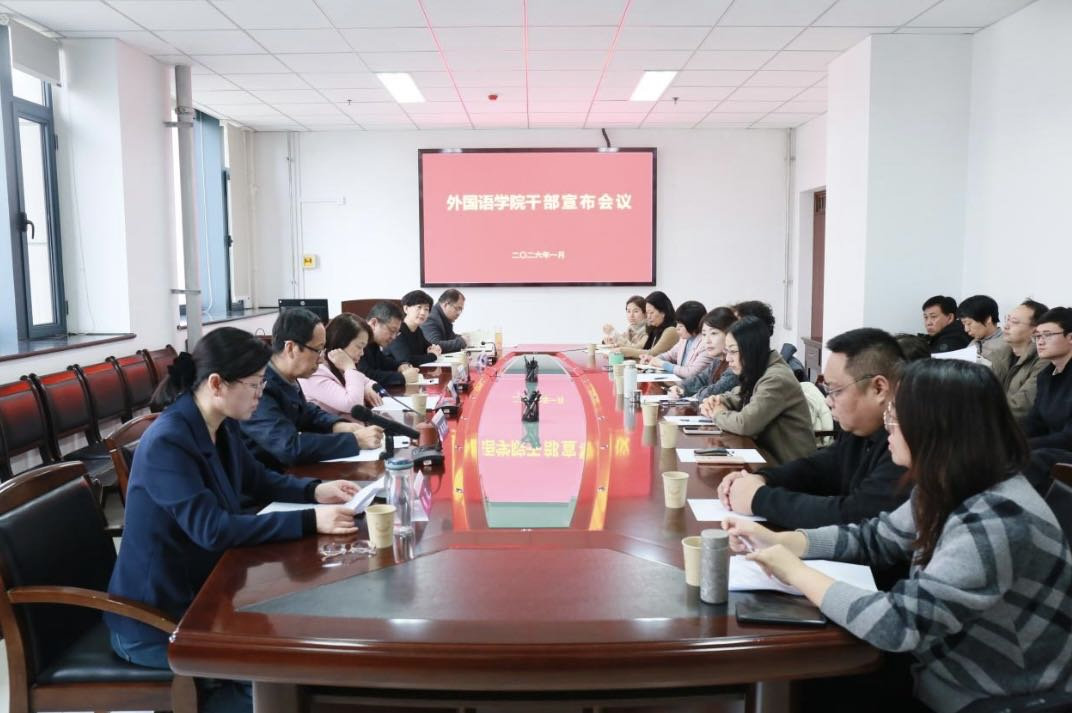
On the morning of January 14, the School of Foreign Languages held a cadre announcement meeting in the school’s conference room. Present at the meeting were Fan Daidi, Member of the Standing Committee of the Party Committee of the University and Vice President. Zhou Chao, Executive Deputy Director of the University Party Committee Organization Department; along with members of the School’s Party, administrative leadership team, department heads, the Trade Union chair, cadres at the section level and above, and faculty representatives. The meeting was chaired by Zhao Zhihou, the Secretary of the school’s Party Committee.
Zhou Chao read out the University Party Committee’s decision on cadre appointments and removals: He Hua was appointed Vice Dean of the School of Foreign Languages, and Su Rui was relieved of her duties as Vice Dean. He Hua and Cao Ruonan each delivered a statement.
In her speech, Fan Daidi acknowledged the School of Foreign Languages’ contributions to improving the quality of talent cultivation, advancing the university’s internationalization, promoting academic research, and facilitating cultural inheritance and innovation. She expressed gratitude for Su Rui’s contributions to the School’s development during her tenure as Deputy Dean and offered hopes for He Hua in her new role. Regarding the construction of the School’s leadership team and its future work, she put forward three expectations: First, focus on the fundamental task of fostering virtue through education and strive to strengthen the central role of talent cultivation. This involves delivering high-quality public foreign language teaching for the entire university and rigorously cultivating foreign language professionals. Second, emphasize distinctive development and integrated innovation to demonstrate new achievements in serving national strategies. This requires leveraging the School’s disciplinary strengths, identifying key areas of focus, and pursuing a development path characterized by differentiation, specialization, and connotation. Third, reinforce the unity and collaboration of the leadership team to forge a strong collective force for the School’s development. This entails strengthening political construction and enhancing ideological unity; strictly implementing democratic centralism and improving internal communication and coordination mechanisms; and taking the lead in upholding integrity and self-discipline while fostering a healthy and positive atmosphere.
 School Homepage
 中文
中文