On June 17, 2026, Professor Chen Jianguo, Foreign Director of the Confucius Institute at the University of Delaware, visited SFL and gave a lecture titled “The Evolution of Sinology: From Language Analysis to Cultural Interpretation,” focusing on the three-century development of Western Sinology and the transformation of research paradigms. The lecture was hosted by Associate Dean He Hua.
Professor Chen began by clarifying core concepts such as Sinology, China Studies, Overseas China Studies, and Post-Sinology, tracing the etymology of “Sino-,” and distinguishing between the narrow philological tradition of classical European Sinology and the broader American system of modern and contemporary China Studies. He also cited the 17th-century scholar John Webb’s theory that “Chinese was the primitive language of mankind” to illustrate early European perceptions of China.
The lecture then traced the evolution of Sinological paradigms through five landmark Sinologists. From the 16th to 18th centuries, Matteo Ricci pioneered Jesuit “cultural accommodation” missionary Sinology. In the 19th century, James Legge established a positivist philological paradigm, systematically translating Confucian classics through textual criticism and exegesis. In the early 20th century, Richard Wilhelm translated the I Ching from an ontological perspective, moving Sinology from textual research toward life-oriented cultural interpretation and deeply influencing Jungian psychology. In the mid-20th century, Jaroslav Průšek completed Sinology’s “literary turn,” exploring the social and spiritual structures of modern Chinese literature from a structuralist perspective. More recently, Stephen Owen drew on postcolonial theory to reflect on discursive power behind cross-cultural interpretation. The lecture also reviewed the development stages of American China Studies, highlighting the essential differences between the area studies model pioneered by John King Fairbank after World War II and traditional European Sinology, and introduced new concepts such as Australia’s “Post-Sinology,” arguing that China should be treated as an equal dialogue partner rather than a mere object of study.
Professor Chen concluded that philology consolidates the empirical foundation of Sinology while hermeneutics expands the boundaries of textual meaning, and the two are complementary. At the end, he interacted with faculty and students on related questions.
The lecture connected Chinese and Western intellectual history and provided new theoretical perspectives and research paths for foreign language faculty and students in cross-cultural and overseas China studies.
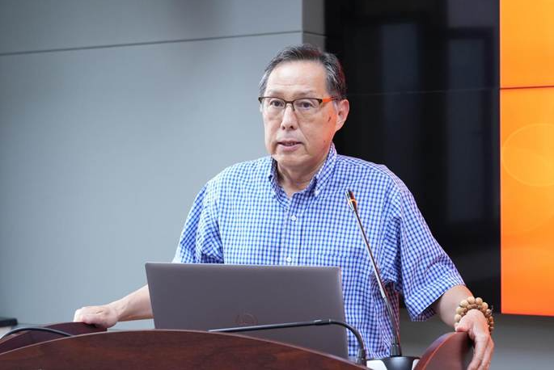
Speaker: Professor Chen Jianguo
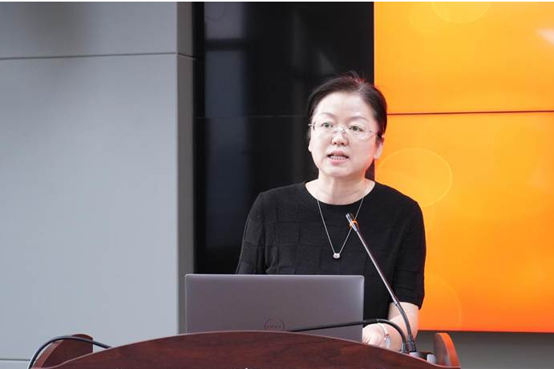
Host: Associate Professor He Hua
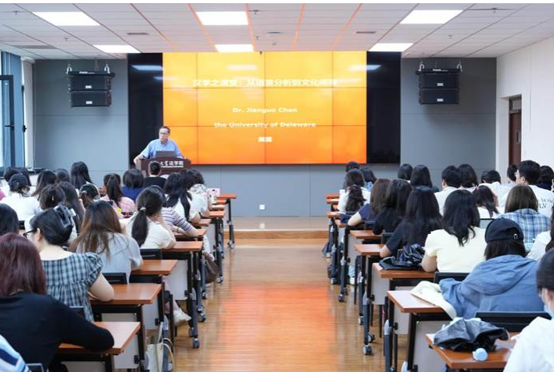
Venue
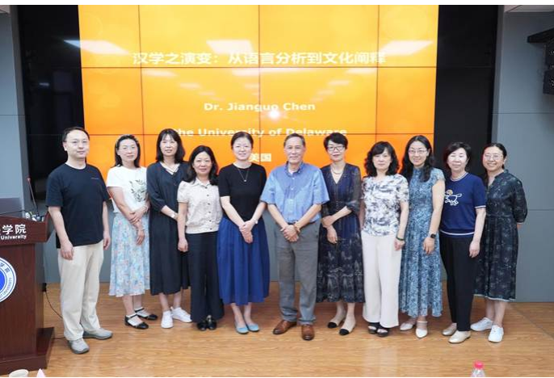
Group Photo
 School Homepage
 中文