On the morning of August 18, the opening ceremony of Northwest University’s “China-Kyrgyzstan Multilingual Perspectives on China’s Modernization Development Study Camp” was held at Taibai Campus. Following the main line of “language empowerment—mutual learning among civilizations—development analysis,” the camp gives full play to SFL’s multilingual strengths, helps Kyrgyz youth understand China’s modernization development comprehensively and objectively from a multilingual perspective, and precisely fulfills the core goal of telling China’s modernization story well. Nineteen young students from Kyrgyzstan, accompanied by their team leader Dr. Sulaimanov Nursultan Sulaimanovich (Su Letan), came to Xi’an for a one-month study and exchange program.
He Wei, Executive Deputy Director of the Office of International Cooperation (and Deputy Dean of the International Education School); Zhang Liyin, Associate Dean of Teaching of SFL; Ji Zhe, Deputy Director of the International Student Admissions Office; Wang Mingwei, Counselor of the International Student Management Office; and faculty and students of the Summer School attended. The welcome ceremony was hosted by Dong Pengfei of the International Student Management Office, with Zhao Pan, Class Advisor of the Summer School, serving as on-site interpreter.
Attendees watched Northwest University’s promotional video to learn about its history, strengths, and international exchanges. He Wei welcomed the Kyrgyz faculty and students. He said China and Kyrgyzstan are linked by mountains and rivers and are good neighbors, with a long history of educational and cultural exchanges. Northwest University, located in Xi’an, the starting point of the ancient Silk Road, has long been committed to deepening educational exchange and talent cultivation cooperation with Central Asian countries. He hoped students would value this opportunity, communicate actively, experience deeply, gain knowledge and friendship while learning about Chinese language, culture, and social development, and add new vitality to China-Kyrgyzstan youth exchanges.
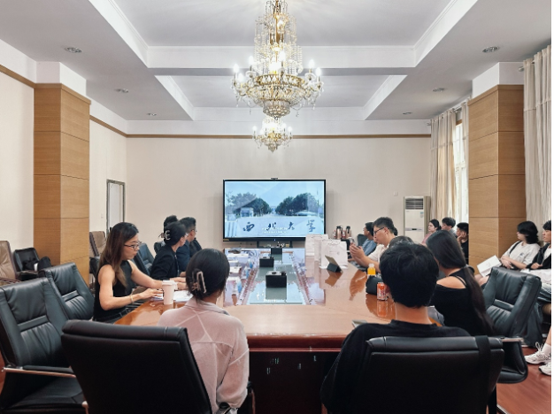
Venue
Associate Dean of Teaching Zhang Liyin introduced the Summer School’s curriculum. In the coming month, the Summer School will fully consider students’ language foundations and learning needs, use Chinese, English, and Russian for teaching and exchange, and combine language learning, cultural experience, and understanding of China’s national conditions. Students will attend special courses, cultural practice, and exchange activities to learn about Chinese language, culture, and modernization from different angles, and experience the blend of tradition and modernity in Xi’an, a city with deep historical heritage and modern vitality.
Kyrgyz team leader Su Letan recalled his study experience in Xi’an and his deep connection with the city. He said he felt very close to Xi’an and was glad to lead students to the Summer School, hoping they would value the opportunity to learn and exchange, better understand China and Xi’an through firsthand experience, and enhance China-Kyrgyzstan youth exchange and friendship.
Student representative Aiida Abibova then spoke, sharing her expectations and feelings about the Summer School. She hoped to improve her Chinese, learn more about Chinese culture, build friendships with Chinese faculty and students, and experience a real, three-dimensional China.
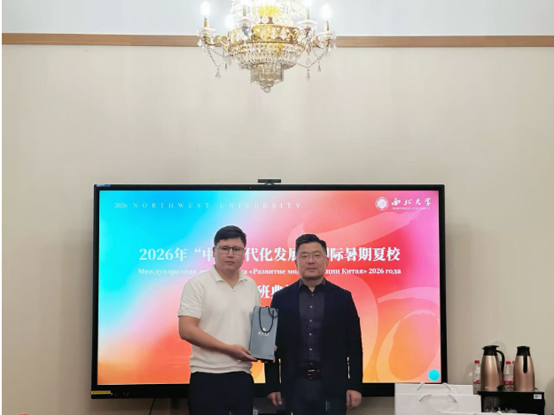
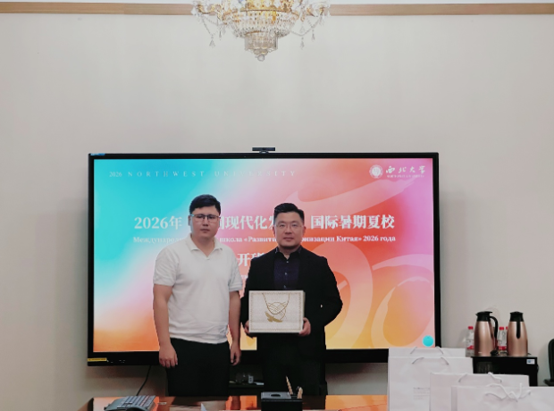
At the end, the university presented souvenirs to participating faculty and students and organized a group photo.
In the coming month, the 19 Kyrgyz students will take part in diverse study and exchange activities at Northwest University. Through classroom learning and cultural practice, they will understand China and its modernization development from historical and contemporary, traditional and modern dimensions. This international Summer School is a positive practice for Northwest University in deepening international educational exchange and strengthening youth exchanges with Central Asian countries, and builds a platform for deepening China-Kyrgyzstan educational and people-to-people exchanges and promoting people-to-people bonds.
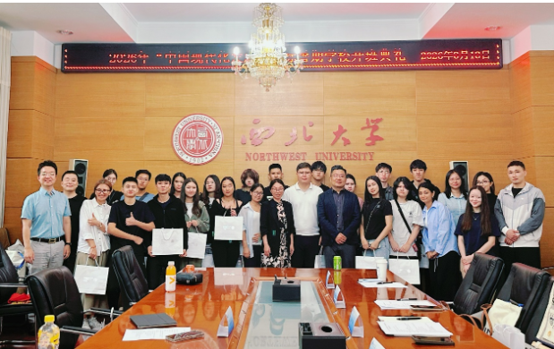
Group Photo
 School Homepage
 中文