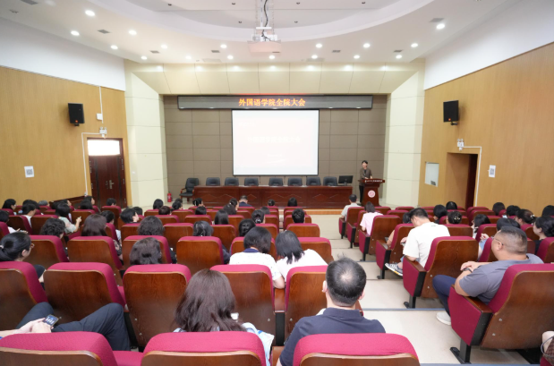
On the afternoon of September 2, 2026, SFL held an all-faculty meeting in Lecture Hall 2. All members of the School’s Party and administrative leadership and all faculty and staff attended. The meeting was chaired by the head of the School’s Party Committee.
Deputy Party Secretary Liu Jianbo outlined student work for the new semester. He said the School will uphold the fundamental task of fostering virtue through education, integrate ideological and political education with the characteristics of foreign language disciplines, and work with industry and enterprises to create a “Telling China’s Story Well in English” campus culture festival. The School will focus on improving pass rates for TEM-4 and TEM-8, deepen coordination between counselors and academic advisors, and implement categorized guidance to precisely address academic risks. Employment work will be advanced early, with a comprehensive survey of the 2027 graduating class and a “one person, one plan” ledger, and one-on-one support for students in difficulty. In addition, psychological surveys will be conducted at the start of the semester, a home-school-medical collaborative intervention mechanism will be improved, dormitory safety and anti-fraud education will be carried out regularly, and the one-stop student community will be further developed.
Associate Dean of Teaching Zhang Liyin outlined key teaching tasks. She stressed that recommendation-based postgraduate admission work will strictly follow procedures to ensure fairness and justice. In disciplinary competitions, while consolidating regular events, the School will focus on the China International College Students’ Innovation Competition and strive for new breakthroughs in national and provincial awards. Facing educational changes in the AI era, the School will strictly implement thesis plagiarism checks, continuously iterate its AI curriculum, and actively promote applications for provincial-level curriculum-based ideological and political education demonstration courses. It will also implement the academic warning system and achieve multi-party joint intervention.
Associate Dean of Research He Hua, aligning with the University’s 15th Five-Year Plan, specified a quarterly reporting mechanism for landmark outcomes. On this basis, the School will precisely empower young faculty growth through customized plans and exchanges with foreign experts to strengthen team collaboration. She said that in the second half of the year, more than ten experts from inside and outside the University will be invited to give lectures, a doctoral forum will be organized, and book publication and policy advisory report submission will be advanced in an orderly manner to improve research output quality through diverse academic activities.
Associate Dean of Administration Yang Ying reported on position adjustments, the renovation of the Faculty Lounge, and new rules on class advisor registration, particularly reminding young faculty to meet professional title evaluation requirements and fill gaps in class advisor or teaching support experience in advance. The School will also accelerate hardware upgrading of language labs, computer rooms, and radio stations at Taibai and Chang’an campuses in accordance with University arrangements, consolidating support for education.
Secretary of the School’s Party Committee Zhao Zhihou noted that academic atmosphere building is crucial to talent cultivation and progression rates, requiring all faculty to work together in classroom education. He further stressed that employment work must continue to intensify, with the whole School working to help students achieve high-quality employment. Academic advisors must fulfill their responsibilities to prevent graduation risks, and faculty should study professional title policies in depth to address development shortcomings.
Dean Cao Ruonan gave concluding remarks based on the University’s summer work meeting. She required all faculty to strictly observe teaching standards and treat teaching competitions as an important platform for honing educational ability. In research, they must ground themselves in national strategic needs, empower academic innovation with AI, and refine real problems. Facing new adjustments in foreign language programs, the whole School must strengthen crisis awareness, align teaching and research with national urgent needs, and serve the University’s internationalization. Finally, she asked all departments to provide good service and support for newly appointed international faculty and strengthen the School’s development community.
The meeting called on all faculty and staff to seize opportunities, take responsibility, and work together to bring the School’s various undertakings to a new level.
 School Homepage
 中文